
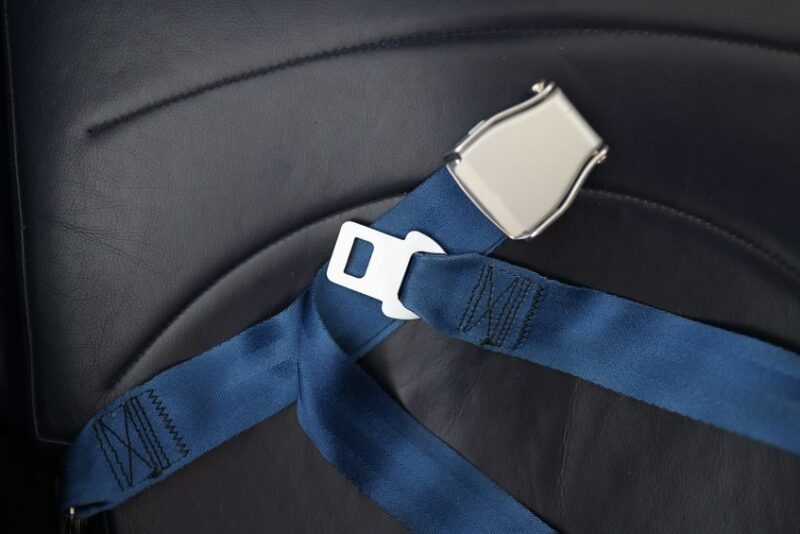
 Most people buckle their seat belts automatically when getting into a car, so it can be surprising to board a school bus and find that passenger seat belts are not always available.
The reason has a lot to do with how school buses are designed. Federal safety requirements differ by vehicle size, and large school buses use several built-in features to help protect passengers in a crash.
If your school, daycare, district, or organization is shopping for school buses for sale, understanding these differences can help you know what to look for.
Why Don’t All School Buses Have Seat Belts?
Federal requirements distinguish between small and large school buses.
According to the National Highway Traffic Safety Administration, small school buses with a gross vehicle weight rating of 10,000 pounds or less must have lap or lap/shoulder belts at designated passenger seating positions.
Large school buses are designed differently. Rather than relying solely on seat belts for passenger protection, they use a safety concept known as compartmentalization.
What Is School Bus Compartmentalization?
Compartmentalization is designed to create protective seating areas for passengers.
Large school buses use strong, closely spaced seats with energy-absorbing seat backs. During a crash, the design is intended to help keep passengers within the seating area and reduce the forces they experience.
The design of the bus itself also contributes to passenger protection. Large school buses are heavier and sit higher than many passenger vehicles, which changes how crash forces affect occupants.
That does not mean seat belts cannot be installed in large school buses. Many buses are available with passenger restraint systems, and requirements may vary depending on where and how the vehicle will be used.
When Are Seat Belts Required?
Federal standards establish baseline requirements for new school buses, but states and local jurisdictions may establish additional rules.
School bus seat belt requirements therefore are not identical across the country. Some states require belts on certain newly purchased school buses or establish requirements for particular types of vehicles or passengers.
Because those regulations can change, schools and transportation providers should verify current requirements for the state and jurisdiction where a bus will operate before purchasing a vehicle. The National Conference of State Legislatures traffic safety database is one resource for tracking school bus safety legislation.
Small and Large School Buses Serve Different Needs
Seat belt requirements are just one difference to consider when comparing school buses.
A smaller Type A school bus can be a practical option for daycares, private schools, special transportation programs, and organizations carrying smaller groups. Large school buses provide significantly more passenger capacity and are commonly used for regular school routes and larger groups.
Your organization should consider:
- Typical passenger capacity
- Age and needs of passengers
- Seat belt configuration
- Wheelchair accessibility
- Storage requirements
- Route length and driving conditions
- Applicable state and local regulations
Looking at the entire transportation program instead of one feature can make it easier to select a vehicle that works for your passengers and drivers.
Don’t Overlook Accessibility
Passenger safety also means making transportation accessible to riders with mobility needs.
Some school buses include wheelchair lifts, designated securement areas, flexible seating configurations, handrails, and other accessibility features. Las Vegas Bus Sales regularly carries lift-equipped models alongside traditional passenger buses in its school bus inventory.
If your program transports students or passengers who use wheelchairs or other mobility devices, accessibility should be considered early in the buying process rather than added as an afterthought.
Look at the Complete Safety Picture
Seat belts are an important school bus safety feature, but they are only one part of the vehicle’s overall design. Seating construction, passenger capacity, accessibility equipment, emergency exits, vehicle condition, and the requirements that apply to your transportation program should all factor into a purchase.
Las Vegas Bus Sales carries a variety of new and used school buses for schools, daycares, districts, organizations, and private transportation providers. Our inventory includes buses in different sizes, passenger configurations, and accessibility setups, allowing buyers to compare vehicles based on how they will actually be used.
Whether you need a smaller bus for a daycare program, an accessible model for specialized transportation, or a higher-capacity vehicle for regular routes, browse our new and used school bus inventory to see current options. Our team can also help you compare available vehicles and identify the features that best match your passenger capacity, budget, and transportation needs.
